The History
The History
Home › The History › Timeline
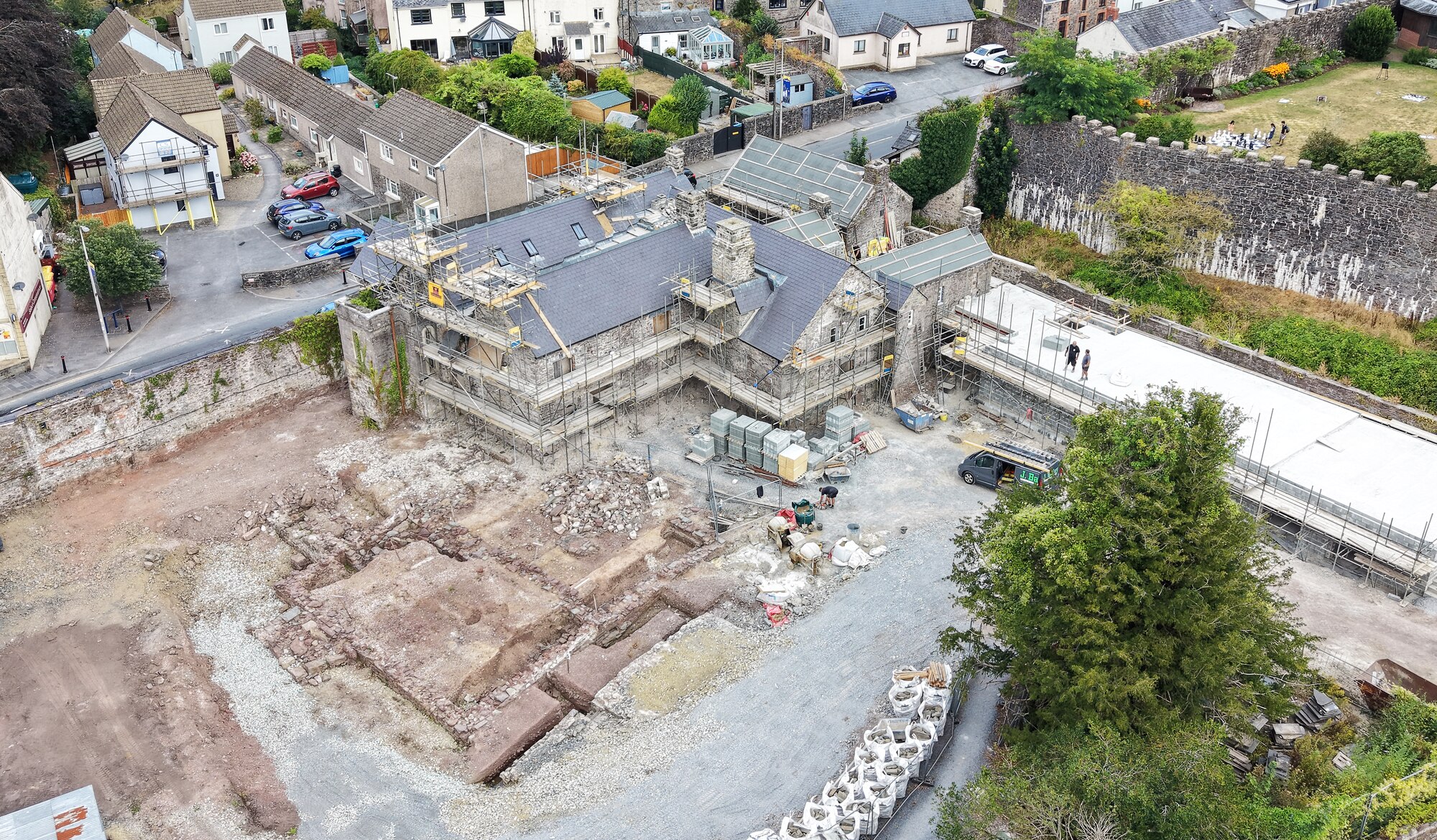
Eight hundred years on one plot beside Laugharne Castle, from a tidal inlet to a house under restoration. Each line is traced to its source. Where the dating is provisional, or a link to this plot is probable rather than proven, the line says so.
Rubbish is dumped into a tidal inlet below the castle. This is Heneb’s provisional phasing of the excavation.
Guy de Brian, lord of Laugharne, is granted a yearly fair at the town.
The de Brian lords grant Laugharne its charter and it becomes a borough, its land held in burgage plots. The exact year is not certain.
Burgage plots are laid out over the inlet and stone quays are built on them. As the inlet silts up, the quays are extended outward (Heneb’s provisional phasing).
The Prydderch family hold burgages below the town gate, probably including this plot. Their line runs back to Elizabeth White, heiress of Jasper White of Laugharne.
A survey of the lordship records James Prydderch holding five of the six burgages “Below the Gate on the South Side”, probably including this plot.
The will of James Prydderch, gentleman of Laugharne, names “one messuage or mansion house wherein I now inhabit”. The will does not say where it stood, so whether it was on this plot is not known.
The short answer is the 1650s, with older work underneath.
The oak for the front-range roof was felled in the winter of 1656/57, and the Cadw listing records a date of 1658 over the yard door. The rear range came a little later: its roof was felled between 1668 and 1674. Cadw dates the standing house to the sixteenth and seventeenth centuries.
The ground is older. The plot was built-up burgage land by 1592. The Cadw listing and Peter Stopp’s 2017 study note earlier work in the house: a straight joint in the street range, and a staircase probably set where an earlier gable-end chimney stood. One oak beam has given a mid-fifteenth-century date; whether it is reused timber or part of an older building is under review.
So the house we see is a build of the 1650s, on a plot in use long before. An earlier house on this exact spot is probable, not proven.
Oak for the roof of the front range is felled.
The year recorded over the yard door.
Oak for the roof of the rear range is felled.
William Skyrme is baptised at Laugharne.
William Skyrme marries Mary Lewis of Henllan.
William Skyrme dies and is buried in the chancel of St Martin’s.
His widow, Mary Skyrme, marries George Stacpoole.
The first known use of the name “Island House”, in a parliamentary return.
The creek wall is rebuilt. Its plaque reads “rebuilt by Maryabra Hughes Skyrme AD 1837”.
Mary Curtis sketches the house. Mary (Lewis) Stacpoole dies.
Mary Abra Hughes Skyrme marries Frederick Wienholt.
Mary Abra Hughes Wienholt dies on 6 January.
Island House is sold at auction.
Major Congreve (formerly Schneider) lives here. He dies at the house on 17 February 1923.
Records show the house bought by Thomas William Morgan, a fish merchant.
Major and Mrs Rose-Richards buy the house.
Caleb Rees, Deputy Chief Inspector of Schools for Wales, retires to Island House. He lives here until 1964.
The owner history records that Caleb Rees sold the house to Dudley and Dorothy Walters. He had built a house on part of the former garden, where he lived until he died in 1970. The Walters family own Island House until 2004.
Island House is listed Grade II* on 25 September.
The house stands empty. In 2012 the council shores it up with scaffolding.
Island House Restoration Ltd buys the house.
The first excavation takes place and repairs begin.
The roof is re-dated by stable-isotope dating. The earlier tree-ring date of 1437 is withdrawn.
Heneb’s excavation uncovers the medieval quays beside the house.
Restoration and research continue.
Sources: Heneb working report (provisional); stable-isotope dating for the Royal Commission (RCAHMW), 2021; Cadw listing 9671; Calendar of Charter Rolls; Lewys Dwnn, Heraldic Visitations of Wales; Francis Jones, “The Squires of Hawksbrook” (1937); the 1592 survey; the 1652 Prydderch will (National Library of Wales); Peter Stopp, “Island House, Laugharne” (2017); parish register; Carmarthen Journal, The Welshman and Carmarthen Weekly Reporter; London Gazette; Dictionary of Welsh Biography; Mary Curtis, Antiquities of Laugharne (1880); the owner history held by Island House Restoration Ltd. More of the house’s people are on Owners & People, and the excavation on The Quay.